



Joan E. Bauer
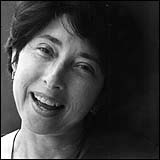 |
Joan E. Bauer is the author of The Almost Sound of Drowning (Main Street Rag, 2008), The Camera Artist, and Fig Season. Her poetry has appeared in numerous journals, including 5 AM, Pearl, Poet Lore, Quarterly West, Slipstream, and US 1 Worksheets, and in nearly a dozen anthologies, among them Along These Rivers: Poetry and Photography from Pittsburgh; Come Together: Imagine Peace (Bottom Dog Press, 2008); Voices from the Attic; and Only the Sea Keeps: Poetry of the Tsunami (Bayeux Arts and Rupa & Co, 2005), which she co-edited with Judith Robinson and Sankar Roy in 2005. In 2007, her poem “Sleepers,” won the Earl Birney Poetry Prize from Prism International. For some years, Joan worked as an English teacher and educational counselor. She now divides her time between Venice, CA and Pittsburgh, PA, where she curates the Hemingway’s Summer Poetry Series, founded by Jimmy Cvetic, with Kristofer Collins. Listen in on the Hemingway’s Summer Poetry Series archive.
I drive all the way to Baltimore
for a blind date with a Chekhov scholar.
The tremor in his hands,
the way his sugar rises as he eats
three carrots. His soft-yolk eyes
dancing helplessly.
In the ladies’ room,
blink at the uncertain woman
in the mirror, wonder
If you’re free to do whatever you want,
why are you doing this?
Back with the diabetic Russian,
distract myself thinking how
sometimes in life (as in Chekhov)
nothing happens.
Then wonder, what’s this poor guy thinking
and whom might I remind him of—
Madame Ranevsky,
the profligate widow.
Varya, almost a nun.
Anya the idealist,
soul-starved, grasping whatever poison
is pushed her way—
All of them at once?
Just then he stops pushing carrots
around his plate, says to me:
In Chekhov, the pain is unbearable.
This poem first appeared in Pittsburgh City Paper.
All the new poems are about loss.
Freud knew: how from the first, our hopes are thwarted.
The squirming body: baby-lips suck-suck,
but the bounteous breast moves on.
How in our dreams, the floorboards fall away
and our loved ones forget they even know us.
We are flying west at 30,000 feet, and I remember
growing up, knobby, obstinate, squelchy
with the dampness of my dreams.
I think of Levertov: I know this happiness is provisional.
It is just that Joseph is beside me, reading a mystery,
and wearing the purple corduroy shirt. We are floating
on a thin broth of clouds, above a green patchwork,
with roads like curving threads. And I wonder:
Is that a shallow lake? Is that a flood plain?
I say, They should give you a shirt that reads—
“Joseph, the famous poet from Pittsburgh,”
He shrugs me off, Too many famous poets.
And I give him a little squeeze, and he says,
No fondling on the airplane. Below the trees
are dark moss, and we are entering the clouds.
This poem was first published in Along These Rivers: Poetry and Photography from Pittsburgh (Quadrant, 2008)
After the fire, we wanted comedy,
for some crazy reason: Woody in Sleeper
as the hapless nerd, frozen (in aluminum foil)
to awaken in 2173: the silver-headed robot,
the Orgasmatron, all the loopy sight gags.
Night after night, we’d laugh, then lie awake
listening to the midnight trains rattling:
engine, box cars, hoppers.
Years later, roaming
the net I find, for upscale paranoids: a ‘sleeper
security bed’ the ultimate in protection from
hurricane, tornado, flood & bio-chem attack.
Bed as safe-room: metal re-enforced, with CD,
microwave, short wave—think I made this up?
Fish called sleepers, four-eyed, stripe-cheeked,
duck-billed, recede into the burrows & crevices
& coral reefs or simply die because they have no—
What is a pelvic sucker?
Maybe the whole country
should go ice fishing—hunker down in sleepers
look for pike & muskie & jumbo perch. Not that
we want the fish—
but solitude,
no phone, no pager.
Propane & poles & a chance to wear heavy coats
& funny fur hats. Long ago building wooden bridges
took strong supporting beams, transverse planks.
Sleepers: strong timber, like the sleepers of a ship,
the valley rafters of a roof—
what’s unseen, yet holds.
They call Africa the ‘sleeping’ continent & why
shouldn’t they be sleeping: refuge from war & hunger
& disease, yet the folks in Chad, Uganda, even Kenya
will tell you—they’re heading toward a better world.
We’re like that, aren’t we—
wanting to believe.
Even if we’re just the framing timber:
sleepers on the rails.
This poem first appeared in the Prism International 45:3, and won the 2007 Earl Birney Prize for Poetry. All three poems above appear in The Almost Sound of Drowning (Main Street Rag, 2008)