



Nancy Esther James
 |
| |
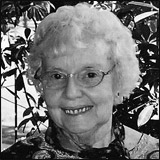
Nancy Esther James has had her poems published in a variety of literary journals and magazines, including Christianity and Literature, Time of Singing, and Poet Lore, as well as in Friends Journal and the Pittsburgh Post-Gazette. Her poem "To a Friend, " originally published in Christianity and Literature, was reprinted in the 2003 Poet's Market. Her books of poetry include No Time to Hurry and A Leap of Vision (Dawn Valley Press, Westminster College, 1979 and 1989), and Resilient Spirit: Poems for Lorraine (Finishing Line, 2013). She has taught poetry workshops at the St. Davids Christian Writers' Conference and The Writing Academy Writer's Weekend.
I Collect
bookmarks in unread books,
drafts of poems in handout copies
so old, they’re purple dittos,
letters, cards I’ll never read again.
I collect family photos
the oldest, a studio pose:
young couple at turn of century
my mother their baby in long gown
the newest, a teen’s half-smile
framed in backyard greenery:
great-nephew with autism
photographed by his dad.
I keep collections no longer whole:
a friend’s blue-glazed ceramics
mug and freeform vase intact
but the candleholder shattered
my brother’s last surviving china dogs,
King Charles spaniel, woebegone beagle;
three elephants, their trunks upraised,
remnants of my mother’s herd
and taken from my father’s pockets:
initialed tie clips, company lapel pins
quotations in his wife’s penmanship
a newspaper clipping—my young face.
bookmarks in unread books,
drafts of poems in handout copies
so old, they’re purple dittos,
letters, cards I’ll never read again.
I collect family photos
the oldest, a studio pose:
young couple at turn of century
my mother their baby in long gown
the newest, a teen’s half-smile
framed in backyard greenery:
great-nephew with autism
photographed by his dad.
I keep collections no longer whole:
a friend’s blue-glazed ceramics
mug and freeform vase intact
but the candleholder shattered
my brother’s last surviving china dogs,
King Charles spaniel, woebegone beagle;
three elephants, their trunks upraised,
remnants of my mother’s herd
and taken from my father’s pockets:
initialed tie clips, company lapel pins
quotations in his wife’s penmanship
a newspaper clipping—my young face.
Fourth of July in Nagoya, 1992
A Rising Sun flies between two Old Glories.
Ro-san-je-res in Japanese phonetics
labels the park “Los Angeles” Plaza.
Replicas of Hollywood names in stars
gild the paved walk around swimming carp.
FOURTH OF JULY IN NAGOYA
shouts the banner
above a live U. S. Marine band.
Hundreds of the city’s gaijin,
welcomed to its party for them,
stroll the paths as though back home,
sunburnt faces split by grins.
Free popcorn and Hagen Daaz!
Free phone calls to anywhere in the States!
Putt three golf balls, get a sample-size Coke
whether you sink one or not.
Land a giant foam rubber ball on a square—
win a Tom Selleck “Mr. Baseball” shirt.
Nagoyans amble among the strangers,
observe them with cool dark gaze.
The skyscrapers around Rosanjeres Praza
echo “Country roads, take me home.”
A young woman, image of a Barbie,
wins third prize in the karaoke contest.
Centered in the gold-flecked pond
a policeman, calm as a statue,
stands alone on a flat rock,
keeps the peace.
A Rising Sun flies between two Old Glories.
Ro-san-je-res in Japanese phonetics
labels the park “Los Angeles” Plaza.
Replicas of Hollywood names in stars
gild the paved walk around swimming carp.
FOURTH OF JULY IN NAGOYA
shouts the banner
above a live U. S. Marine band.
Hundreds of the city’s gaijin,
welcomed to its party for them,
stroll the paths as though back home,
sunburnt faces split by grins.
Free popcorn and Hagen Daaz!
Free phone calls to anywhere in the States!
Putt three golf balls, get a sample-size Coke
whether you sink one or not.
Land a giant foam rubber ball on a square—
win a Tom Selleck “Mr. Baseball” shirt.
Nagoyans amble among the strangers,
observe them with cool dark gaze.
The skyscrapers around Rosanjeres Praza
echo “Country roads, take me home.”
A young woman, image of a Barbie,
wins third prize in the karaoke contest.
Centered in the gold-flecked pond
a policeman, calm as a statue,
stands alone on a flat rock,
keeps the peace.
Pascha’s Story
dedicated to Animal Friends
A human found me stumbling, crying,
bleeding from a hind leg chewed
by sharp shiny teeth from no muzzle,
no creature I could fight.
Something pricked me to sleep.
I woke to know the ruined leg gone—
gone, too, tiny lives I’d sensed inside me.
I rested, ate in a narrow space,
learned to walk a new way.
Hands carried me to a larger room
where two once-toms already lived,
one lazy, the other slim, nervous.
Every day humans came in, left us food,
cleaned the sand in our boxes.
My one hind leg grew stronger.
Whenever a furless face appeared
in the clear square on the door,
I’d jump onto a soft-covered ledge,
mew, beg the person in. Some answered,
stroked me, murmured their kind of purr.
I might have stayed the rest of my life.
Then one of their females held me longer—
went away, came back, lifted me into a box,
brought me here where I gaze on a garden,
spy on squirrels and birds all day.
I sleep on her bed, explore her clean world,
purr back to her as she brushes my fur.
I hope to live here the rest of my life.
dedicated to Animal Friends
A human found me stumbling, crying,
bleeding from a hind leg chewed
by sharp shiny teeth from no muzzle,
no creature I could fight.
Something pricked me to sleep.
I woke to know the ruined leg gone—
gone, too, tiny lives I’d sensed inside me.
I rested, ate in a narrow space,
learned to walk a new way.
Hands carried me to a larger room
where two once-toms already lived,
one lazy, the other slim, nervous.
Every day humans came in, left us food,
cleaned the sand in our boxes.
My one hind leg grew stronger.
Whenever a furless face appeared
in the clear square on the door,
I’d jump onto a soft-covered ledge,
mew, beg the person in. Some answered,
stroked me, murmured their kind of purr.
I might have stayed the rest of my life.
Then one of their females held me longer—
went away, came back, lifted me into a box,
brought me here where I gaze on a garden,
spy on squirrels and birds all day.
I sleep on her bed, explore her clean world,
purr back to her as she brushes my fur.
I hope to live here the rest of my life.